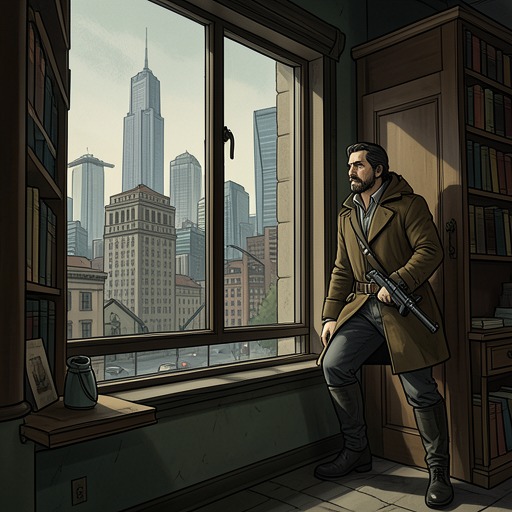
Travis's journal
Taxi DriverTravis's journal is both a record of daily impressions and a private instrument of self-construction. Begun to help him remember, occupy himself, and keep from losing control, it preserves the gap between what Travis does in public and what he tells himself in private. Its entries move from street observations to romantic fantasy, political self-presentation, violent planning, and an explicit reckoning with solitude.
Beginnings and the City
Travis says he began keeping the journal on a day of dirty snow, after mentally recording the city's grime and the bleakness of the morning. He compares soot falling on snow to pepper on mashed potatoes and notices men without fingers washing taxi windshields with large yellow sponges. These sharply specific details establish the journal's initial purpose: not to explain the city, but to retain passing sights that might otherwise dissolve into the routine of his shifts. Writing offers occupation and a means of keeping himself together amid a world he experiences as harsh and alienating.
The early entries also make the journal a storehouse for thoughts Travis does not communicate. He chooses April 14 as Betsy's birthday, linking the date to their first exchange of glances a week earlier at 58th Street and Broadway. He knows almost nothing about her, yet imagines that she might be the woman with whom he could belong. The mismatch between scant knowledge and certainty is important: the journal records not only events but the speed with which Travis turns an encounter into a private story about intimacy.
Betsy and the Unsent Pages
Travis uses the journal to compose messages intended for Betsy to read someday. One draft presents him as employed and deeply concerned about the country's future, offers his help to Charles Palantine, and asks to meet and talk. Another calls Betsy beautiful and clean and proposes friendship. These drafts reveal a carefully fashioned approach: he tries to make himself appear politically engaged, earnest, and suitable for contact, while the journal itself holds the appeals he has not yet delivered.
The entries also register how fantasy outruns the relationship. Travis writes a poem in private but does not intend to send it, and his imagined intimacy coexists with the fact that he still knows little about Betsy. Later, he records that on April 27 he called her at the office and arranged to go to the cinema the following evening, his day off. The journal thus preserves a real step toward contact alongside the larger, unverified hopes he has built around her.
Public Roles and Private Claims
The journal dates Travis's growing attention to Palantine's campaign: between taxi fares, he finds reasons to pass the campaign headquarters and watch Betsy at work. On April 27, the day he calls her, he also picks up three well-dressed men in the northern part of the city; one is Palantine himself. Travis records the senator's physical presence as making him seem more real than he had from a distance. The entry places his private fixation on Betsy beside an unplanned encounter with the politician whose campaign defines her workplace.
At Palantine's rally, the boundary between journal writing and performance becomes especially visible. While the senator speaks to an applauding crowd, Travis composes a letter to his parents in his mind and writes its claims into the journal. He says he cannot provide his address because the sensitive nature of his army work requires secrecy; he also claims to be healthy, earning good money, and dating Betsy. These assertions are presented as a private draft, not as confirmed facts about his life. The journal captures Travis rehearsing an image of himself for absent readers even as the public scene around him supplies a contrasting view of Palantine's persuasive political performance.
A conversation with a man he takes to be connected to the Secret Service shows the same impulse to shape how others see him. When asked whom he has noticed, Travis improvises an answer and then says he might make a good agent because he is observant. The episode is not itself identified as a journal entry, but it illuminates the journal's pattern of self-presentation: Travis repeatedly tries out identities—political supporter, secretive serviceman, potential agent—that make him seem purposeful and capable.
Planning, Solitude, and the Journal's Record
As Travis's thoughts turn toward attacking Palantine, the journal's observational function gives way to preparation. He gathers information about Palantine's route from Kennedy Airport to The Plaza Hotel and around the city, and about the protective detail's deployment as reported in the Times. He describes assembling a hunting plan, memorizing the route, and practicing a draw with a .44 Magnum. He also records a concealed mechanism designed to slide a Colt .25 into his palm, a modified Western shirt to accommodate it, and a military combat knife attached to his calf. The difficulty of concealing the weapons becomes part of the account: layered shirts and a jacket hide their outlines but leave him dressed for arctic winter as the weather grows hotter. The journal therefore documents violence not as an abstract intention but as a sequence of research, rehearsal, and practical adjustments.
After leaving Iris, Travis goes to a shooting range and fires repeatedly with the weapons he has brought. At home, he writes that solitude follows him through bars, cafés, cinemas, shops, and streets, and that his work conceals a deeper sense of idleness. He also records a refusal to keep collapsing into ridicule and a question about whether any hope remains. That night, he drives while watching people go by in pairs, with himself alone. The entries turn the journal back toward its earliest purpose: to give form to an experience he cannot resolve through work or company.
The record also shows Travis seeking small signs of recognition. In the morning, he enters shops to meet proprietors, walks around so that people will notice him and exchange a friendly word, and withdraws five new hundred-dollar bills from the bank. He folds the money into a letter addressed to Iris. The journal's movement from private observation to unsent messages, rehearsed identities, tactical plans, and attempted gestures of connection makes it more than a simple logbook. It is where Travis records his actions while also trying to author a version of himself that those actions repeatedly unsettle.